CUSTOMER SUCCESS STORY
Illuminating Protein Dynamics with Precision
How Coherent Sapphire Lasers Empower Groundbreaking Single Molecule Spectroscopy Research
Customer Background and Challenges
Before implementing Coherent’s Sapphire laser solution, Professor Hübner’s research team faced a significant technical challenge: finding a laser source with exceptionally low noise, outstanding power stability, and precise pointing performance.
Their experiments required long-term measurements of photon emission fluctuations across time scales from nanoseconds to seconds. Long-term beam pointing stability was critical in order to maintain reliable alignment and reproducibility required for coupling of multiple laser wavelengths into a single-mode fiber for fluorescence excitation in a confocal microscope.
At the core of Professor Hübner’s research lies Single Molecule Spectroscopy, a powerful method to observe and measure the dynamics of individual protein molecules. By labeling proteins with different fluorochromes, each excited by specific laser wavelengths, the team can track protein conformational changes in real time.
Such precision demands laser wavelengths that precisely match the fluorochrome absorption lines, combined with high beam quality and exceptional power stability, a requirement that many competing laser systems could not fully meet.
Solution: Coherent Sapphire Lasers
After extensive evaluation, Professor Hübner selected Coherent Sapphire lasers, which offered an unmatched combination of wavelength flexibility, low noise, and superior beam quality.
Built on Optically Pumped Semiconductor Laser (OPSL) technology, Coherent’s Sapphire laser series provides a broad portfolio of visible wavelengths, allowing perfect matching to the fluorochrome absorption peaks. The lasers’ TEM₀₀ single-mode beam quality ensures tight focus for confocal microscopy, while an integrated output power control loop delivers exceptional long-term power stability with intrinsically low noise.
Implementation was effortless. Despite the complexity of the research setup, the compact Sapphire head (with a footprint not larger than the size of a smartphone) allowed seamless integration even in space-constrained optical benches. Connection via the provided head cable and control through either analog or USB interface made installation quick and intuitive.
“The Sapphire lasers were incredibly easy to implement. Their compact design and excellent stability made integration into our existing setup almost effortless.”
— Prof. Hübner
Results and Benefits
Since adopting Coherent Sapphire lasers, Professor Hübner’s lab has achieved highly stable, maintenance-free operation, enabling researchers to focus on advancing scientific discovery rather than troubleshooting instrumentation.
Key benefits include:
- Hassle-free operation and minimal maintenance, increasing uptime and productivity.
- Extremely low noise, ensuring clean and reliable fluorescence excitation for precise molecular measurements.
- Flexible wavelength selection, perfectly tailored to experimental needs.
“Sapphire lasers deliver exactly what we need—stability, low noise, and reliability. They’ve allowed us to concentrate fully on our research instead of worrying about the laser.”
— Prof. Hübner
Future Outlook
Professor Hübner continues to rely on Coherent Sapphire lasers as a cornerstone of his ongoing research in molecular biophysics. Their combination of performance, reliability, and ease of use has already inspired him to recommend them to other researchers in the field.
"The Sapphire lasers were incredibly easy to implement. Their compact design and excellent stability made integration into our existing setup almost effortless"
— Prof. Hübner, Institute of Physics, University of Lübeck, Germany


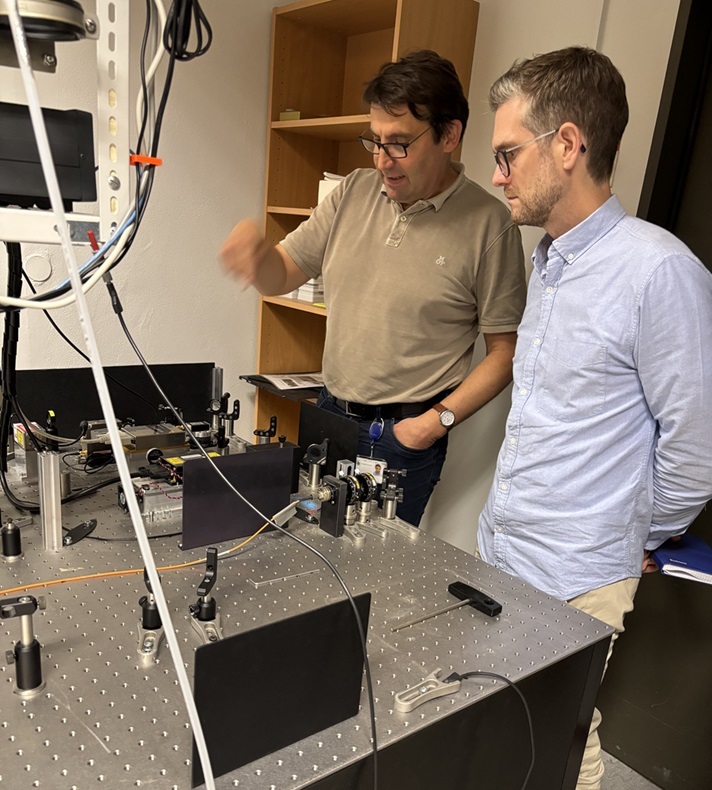
Figure 1. Professor Hübner explains his set-up including a confocal laser scanning microscope with a Coherent Sapphire laser.

Figure 2. CDRH conformant model of the Sapphire laser with an emission wavelength of 488 nm
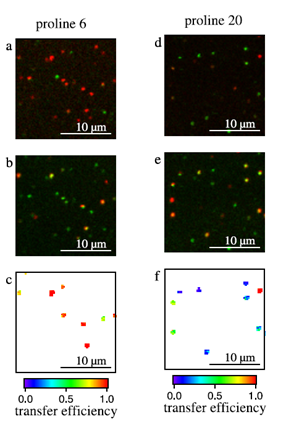
Figure 3. Single-molecule FRET (Förster Resonance Energy Transfer) measurements using a 488 nm Sapphire laser at 77 K (source: Hirschfeld, Paulsen & Hübner, The spectroscopic ruler revisited at 77 K, Phys. Chem. Chem. Phys. (2013). https://doi.org/10.1039/c3cp51106e)