400G Lanes: The Next Inflection Point for AI Datacenters
(Source from Dr Anna Tatarczak, ECOC 2025 Market Focus)
May 18, 2026 by Coherent

Artificial intelligence is driving a fundamental shift in how datacenter infrastructure is designed and scaled.
From large-scale model training to real-time inference, AI workloads are driving unprecedented volumes of data across datacenters. This surge is placing enormous pressure on networking architectures, particularly the optical interconnects that move data between compute nodes.
As these demands accelerate, the industry is approaching a critical transition point. The next leap forward is clear: 400 gigabits per second (Gbps) per optical lane.
A Shift Beyond Incremental Speed Gains
For years, datacenter networks have evolved through steady increases in lane speed from 50G, to 100G and then 200G. Now, the move to 400G per lane represents more than just another step in that progression.
It fundamentally changes how systems are designed.
Higher lane rates enable:
- fewer optical fiber lanes per module
- reduced signal processing (DSP) complexity
- lower cost per bit
In effect, 400G per lane simplifies architecture while enabling greater scalability, an essential combination as AI infrastructure expands.
AI Workloads Redefine Network Requirements
Unlike traditional cloud workloads, AI systems rely heavily on parallel processing across thousands of GPUs or accelerators. These systems generate massive “east-west” traffic within datacenters, requiring constant synchronization across nodes.
Even small delays can cause significant inefficiencies. Hence, bandwidth density, signal integrity, and control over latency variation are as critical as raw data rate. For the system design perspective, 400G per lane implies higher bandwidth density, latency control and increased needs for thermal and power management. Moreover, the transmission distance is limited by the loss in the electrical cables and by chromatic dispersion for fiber reach.
In this context, increasing the data rate per lane is . to 400G is not merely a matter of increasing transmission speed. It impacts several dimensions of the overall AI system architecture: only a careful co-optimization of these aspects can ensure reliable operation and efficient scaling at the cluster level.
Technology Innovation Across the Optical Stack
Achieving 400G per lane requires innovation across multiple layers of the optical ecosystem.
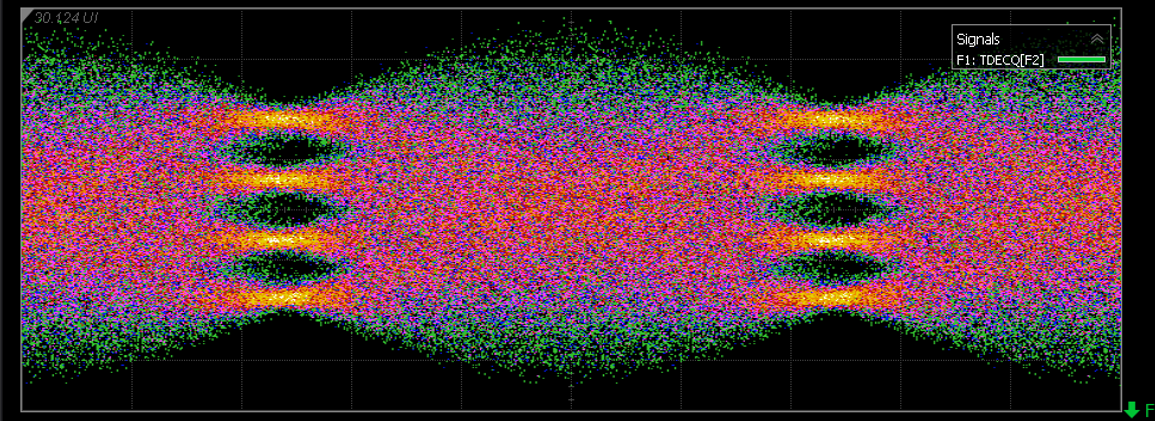
In order to support 400G PAM4 transmission, the modulator should guarantee close to 100GHz bandwidth. Different material platforms and device architectures are being explored, each with unique advantages:
- Silicon photonics (SiPh) for integration and scalability
- Indium phosphide (InP) for native laser integration and high bandwidth
- Thin-film lithium niobate (TFLN) for ultra-high bandwidth and linearity
Other new modulator materials - like polymers and Barium Titanate (BTO) - are also explored.
Similarly, different modulator designs offer trade-offs between performance, footprint, and efficiency:
- Ring modulators: compact, strongly temperature dependent resonance
- Mach-Zehnder modulators: higher performance, larger footprint, higher drive voltage
Electro-absorption modulated lasers (EML) and Differential EML: more compact and power efficient
On the receiver side, achieving bandwidths near 100GHz requires careful co-optimization of photodetectors and transimpedance amplifiers to maintain signal fidelity at these extreme speeds, with materials such as Germanium and Indium Phosphide playing a key role.
From Bandwidth to System-Level Performance
As lane speeds increase, the key performance metrics are evolving.
Traditional considerations such as power, reach, and cost remain important. However, new system-level factors are becoming decisive:
- Latency determinism, particularly for synchronized AI workloads
- Bit error rate (BER) and signal integrity
- Forward error correction (FEC) overhead, which impacts latency itself and system throughput
- Linearity, especially for multi-level modulation schemes
- Reliability, to reduce downtime and avoid costly retraining cycles of AI/ML models
At 400G per lane, system performance depends on how effectively these parameters are balanced. It is determined by how well the entire system manages these complex trade-offs to guarantee signal integrity.
Shorter Reach, Smarter Architecture
Increasing lane speeds introduces new constraints. Optical effects, such as chromatic dispersion, limit achievable distances, requiring advanced compensation techniques for longer reach.
Depending on the laser type, the maximum reach that can be supported at 400G typical spans from 0.5km to 1.5km.
Interestingly, most datacenter links remain relatively short. The majority are under 30 meters, especially in AI-driven environments where tightly coupled systems dominate. In the new AI/ML datacenter, links are expected to be even shorter. In order to overcome the distance limitation, reach can be extended using Maximum Likelihood Sequence Estimation (MLSE) or optical Chromatic Dispersion compensation.
Packaging, Cooling, and the Next Generation of Form Factors
As electrical bandwidths exceed 100GHz, the physical challenges of interconnect design become more pronounced.
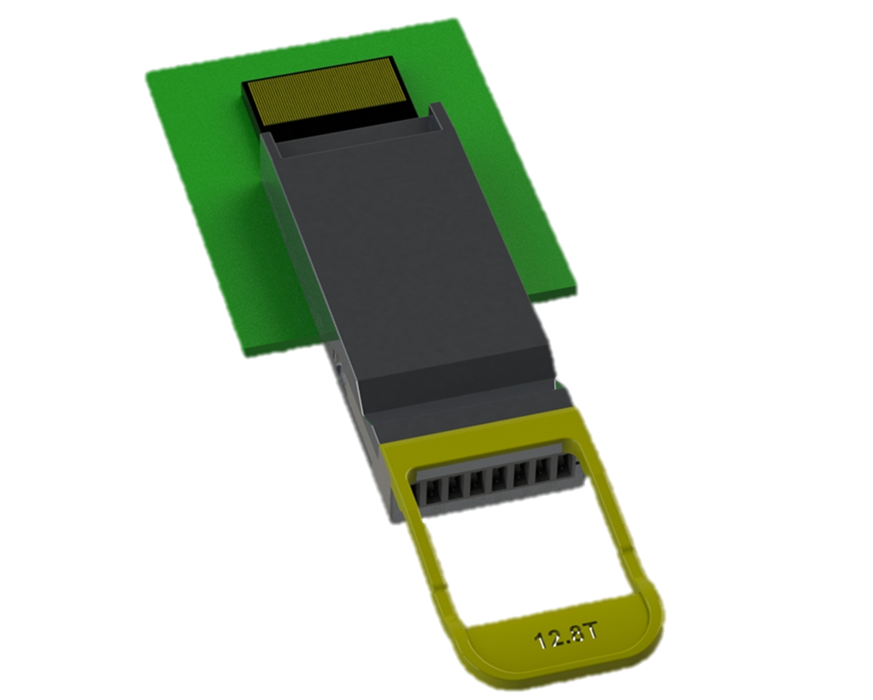
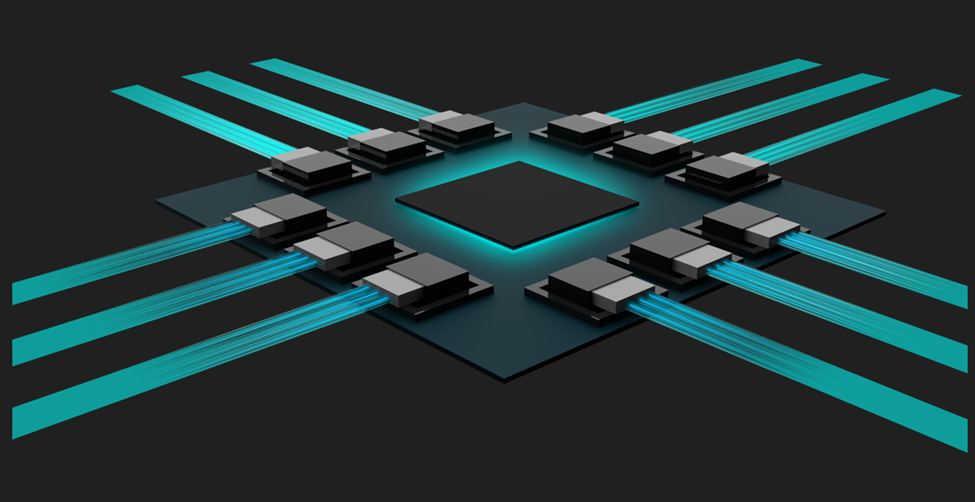
New form factors, both pluggable and socketed, are being developed to support higher data rates while maintaining signal integrity. These designs require tighter manufacturing tolerances across connectors, cables, and printed circuit boards.
At the same time, thermal management is emerging as a critical constraint. With increasing power densities, liquid cooling is becoming a practical necessity for next-generation optical modules.
A Defining Moment for Datacenter Evolution
The transition to 400G per lane marks a pivotal moment for the datacenter industry.
It represents a shift from incremental improvements to architectural transformation, where efficiency, scalability, and system-level optimization take center stage.
Meeting these demands requires innovation across the entire technology stack:
- materials
- packaging
- electrical connectors
- ICs
- thermal managementoptical design
- system integration manufacturing process
Companies that can deliver across this spectrum will play a central role in shaping the future of AI infrastructure.
Looking Ahead
As AI continues to scale, the demands on datacenter networks will only intensify.
The move to 400G per lane is a transition that marks the start of the next phase of innovation in optical interconnect technologies. where optical technologies are not just enabling connectivity but defining the limits of performance itself. And it is these challenges that will shape the next wave of progress.


