
Why advanced materials are becoming essential to AI thermal management.
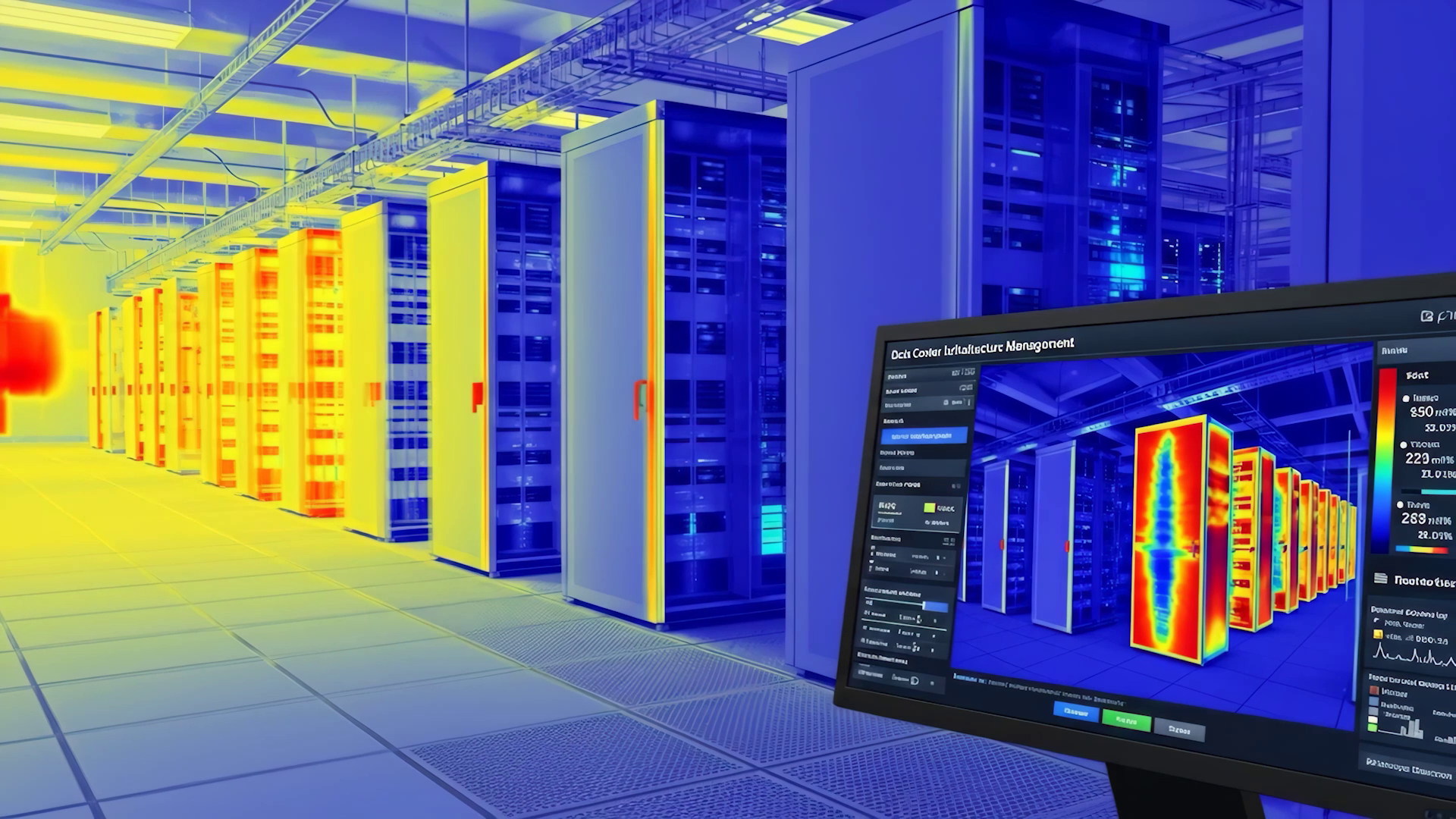
As AI accelerators become more powerful, heat is becoming a fundamental constraint on performance. More power is being concentrated into smaller, denser systems, increasing the importance of thermal resistance of every material and interface. Cooling systems alone cannot solve this challenge. The complete thermal path—from the chip to the coolant—must be engineered to move heat efficiently and reliably.
Coherent addresses this challenge with advanced materials and thermal-management technologies, including diamond, silicon carbide and engineered composites. Our solutions range from Thermadite liquid cold plates to diamond heat spreaders and silicon carbide wafers designed for high-voltage, energy-efficient power devices.
For datacenters, this is more than a technical challenge. Higher temperatures can reduce system reliability, increase energy consumption and limit the performance that AI infrastructure can deliver.
AI is approaching a thermal limit
For decades, semiconductor scaling delivered more performance without a proportional increase in power consumption. As transistors became smaller, they generally required less power per operation — a trend associated with Dennard scaling.
That trend began to break down around 2007. Although transistor dimensions continued to shrink, the gains in power efficiency no longer kept pace. At the same time, AI systems began demanding more compute in increasingly compact architectures.
The result is a growing concentration of heat. What were once isolated hot spots have become hot zones, particularly as systems adopt multi-core designs, advanced packaging and 2.5D and 3D integration.
In other words, performance is increasingly becoming thermally limited—not device limited.
Why cooling alone is not enough
The industry has moved from passive cooling and forced air, to liquid cooling, including direct-to-chip cold plates. These approaches can remove heat more efficiently, but the cooling system is only as effective as the thermal path connecting the chip to the coolant.
Managing heat requires an integrated approach across the entire thermal path. The graphic below illustrates a conventional thermal path and highlights where Coherent solutions can help optimize thermal performance.
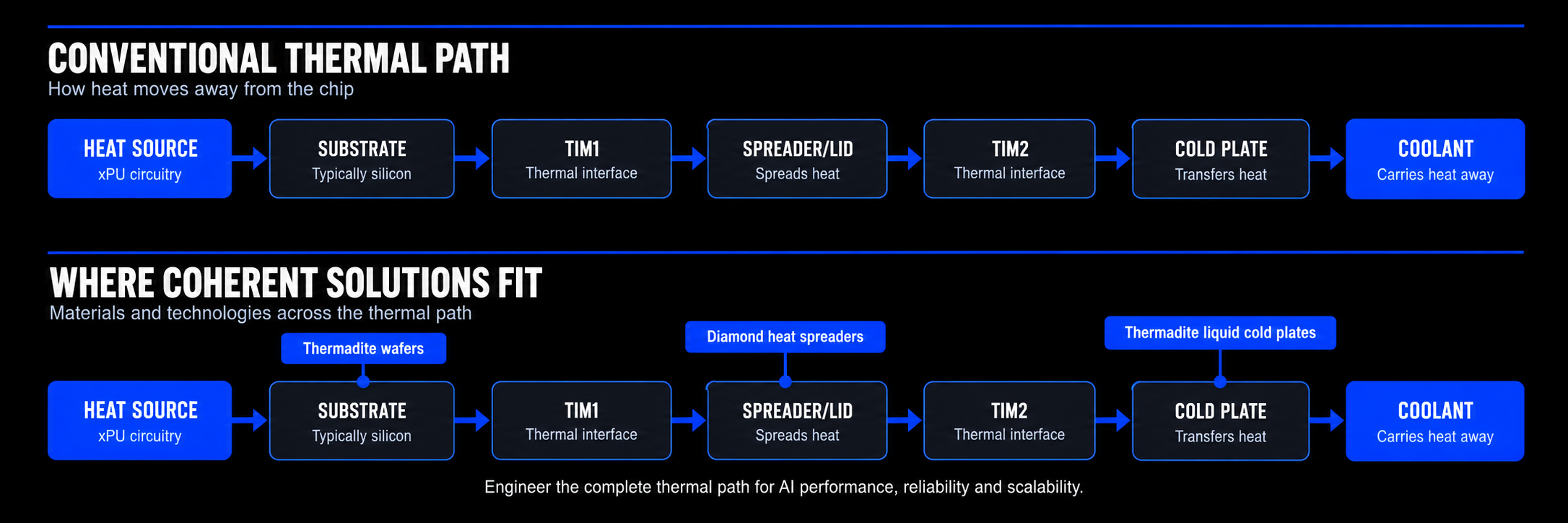
Each step adds thermal resistance. At higher power densities, the interfaces between materials can become the dominant bottleneck. A small amount of resistance at each stage can add up to a significant limitation on heat removal.
This is why simply adding more coolant or increasing flow rates may not solve the entire problem. The materials used to spread and transfer heat are just as important as the cooling system itself.
Cooling is also an increasing significant investment in datacenter infrastructure. McKinsey projects that cooling equipment for AI workloads will attract approximately $220 billion in cumulative spending between 2025 and 2030. As AI datacenters move toward rack densities above 50kW, liquid cooling is becoming a necessity rather than an option—making thermal efficiency critical to performance, reliability and operating costs. More details at Coherent’s thermal management overview.
Advanced materials connect the chip to the application
The materials used along the thermal path must do more than conduct heat. They must also maintain dimensional stability, manage thermal expansion and withstand demanding operating conditions.
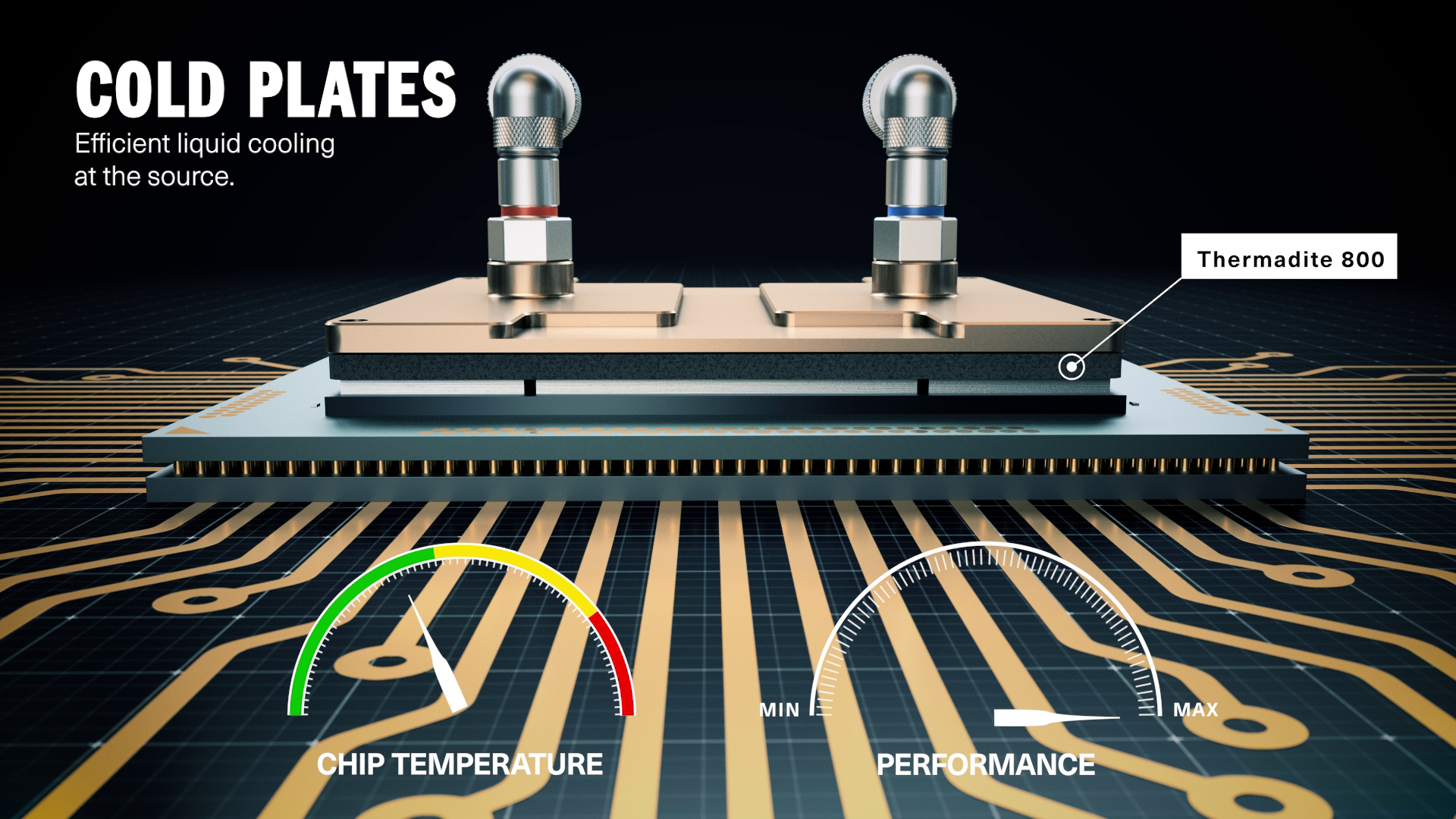
For example, Coherent’s Thermadite™ 800 liquid cold plates combine diamond with a silicon carbide matrix to deliver thermal conductivity of approximately 800W/m-K—around twice that of copper. In high-heat-flux AI accelerator environments, the cold plates have demonstrated chip-temperature reductions of more than 15°C compared with conventional copper cold plates. They also offer approximately 60% lower density than copper, supporting more weight-sensitive system designs. Learn more about Thermadite liquid cold plates.
As Rob Murano, Senior Director, Product Development and Commercialization, explains, “As AI datacenters scale, the heat generated by high-density computing is becoming an increasingly critical challenge. Coherent addresses this challenge with solutions spanning the thermal path—from Thermadite liquid cold plates that extract heat directly from the chip to direct-bondable diamond and Thermadite heat spreaders that distribute heat with minimal thermal resistance. Together, these technologies help enable the performance, reliability and scalability required by next-generation AI infrastructure.”
That perspective is important. The goal is not simply to find a material with high thermal conductivity. It is to engineer the complete thermal path—from the semiconductor package to the cold plate and the cooling system—to work as efficiently as possible.
From component optimization to system-level design
As traditional scaling slows, performance improvements increasingly depend on how the entire system is designed. This includes:
- Advanced packaging and 3D integration
- More efficient direct-to-chip liquid cooling
- Lower-resistance thermal interfaces
- High-conductivity heat spreaders and cold plates
- Materials with a closer coefficient of thermal expansion to silicon
- Integrated designs that optimize for real chip heat maps
These considerations connect materials science directly to practical applications and reducing operating expense for datacenter operators. In an AI datacenter, better heat spreading can support higher-performance accelerators and more consistent operation. In power electronics, materials such as silicon carbide can help enable efficient power conversion and higher-voltage architectures.
Coherent’s broader silicon carbide platform includes substrates and epitaxial wafers designed for high-voltage, energy-efficient devices. Its 300mm SiC substrate platform is being developed to support the power and thermal demands of next-generation data centers, while its thick epitaxy capabilities support power devices up to 10kV for AI data center and industrial power applications. Learn more about Coherent silicon carbide materials.
Explore Coherent’s thermal management solutions:
- Thermal Management
- Thermadite Liquid Cold Plates
- Silicon Carbide Materials